
Skyrmions
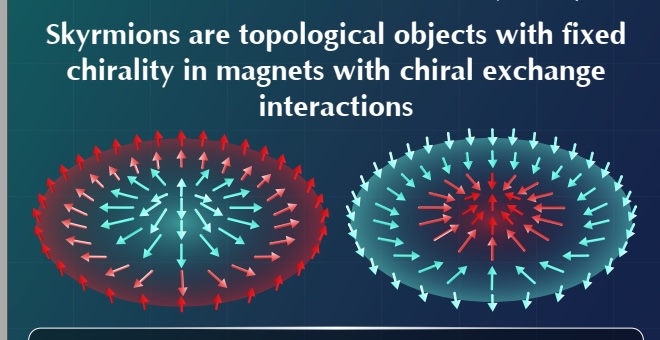
- Imagine a field of arrows all pointing upward. Now take one small spot and gently twist the arrows so that:
- At the center, the arrow points down
- Moving outward, the arrows rotate smoothly
- Far away, everything points up again
The small knot formed by this twist is known as a skyrmion. It’s chiral because the arrows always twist left-handed or right-handed, which one can’t easily “untwist” without tearing the pattern apart. This makes skyrmions very stable.
- Because skyrmions are stable, tiny (nanometers across), and easy to move, they’re promising candidates for next-generation low-power magnetic memory.
Ginzburg-Laudau
One Studies a complex field
$u:\ \Omega \subset \mathbb{R}^n \rightarrow \mathbb{C}$
and the Ginzburg-Landau energy
$E_{\epsilon}(u) = \int_\Omega \frac{1}{2}|\nabla u|^2+\frac{1}{4{\epsilon}^2}(1-|u|^2)^2\ dx$
- In superconductivity, Ginzburg–Landau is a phenomenological theory describing a material near its critical temperature. If $u$ takes values in the complex plane $\mathbb{C}$, then $u$ can describe the wavefunction for a “fluid” of Cooper pairs in a superconductor. $|u|^2$ is the superconducting density.
- This research sits at the interface of harmonic analysis and nonlinear PDE, and it’s motivated by a very concrete failure of compactness. In many geometric and physical PDEs — like Ginzburg-Landau — we only have weak $L^2$ control on gradients, while the quantities of interest are nonlinear and should not converge under weak limits.
From the Ginzburg-Landau equations, when separating their amplitude and phase, one encounters the term
$\rho^2|\nabla \varphi|^2$ = $\nabla \varphi \cdot$ Im($\bar{u}\nabla u)$
where the equations imply div(Im($\bar{u}\nabla u$)) $= 0$
- div(Im($\bar{u}\nabla u$)) = 0 $\Rightarrow$ $\rho^2|\nabla \varphi|^2 \in \mathit{H}^1$
- oscillation $\neq$ noise
- oscillation = topology + conservation
- This beautifully unifies the Hardy/BMO section with GL.
Invariants of Hypersurface Complememts

I showed that when this invariant is finite, it coincides with the degree of the Alexander polynomial of the hypersurface:
$\delta_0(\mathit{C})$ = deg($\Delta_\mathit{C}$)
where $\delta_0(\mathit{C})$ is defined as $dim_\mathit{K_0} \mathit{H_1}(\mathbb{C^2}\setminus \mathit{C}; \mathit{R_0})$, the size of the vector space of first homology of the complement after isolating the essential linking direction.
- Because some spaces’ fundamental groups are complicated and hard to access directly, I studied topological invariants of the complements of the complex hypersurface. Concretely, I studied complements of plane algebraic curves:
$\mathit{C} = \mathit{Z}(f) \subset \mathbb{C}^2$
and the topology of
$\mathbb{C}^2\setminus\mathit{C}$.
- Via the linking number homomorphism, $f_*: \pi_1(\mathbb{C}^2\setminus\mathit{C}) \rightarrow \pi_1(\mathbb{C}\setminus\{ 0 \}) \cong \mathbb{Z}$, which measures how loops in the complement wind around the hypersurface.
- This work provides a homological interpretation of the degree of the Alexander polynomial.
Gaussian Measure
- A Gaussian measure in infinite dimensions is a probability measure defined by Gaussian behavior of all linear functionals, whose geometry is controlled by a hidden Cameron–Martin Hilbert space rather than translation invariance.
It is closely related to Harmonic Analysis in that my research studied how function spaces built on those measures behave, and how symmetry survives in infinite dimensions. It investigated representations of groups (here, translations) on function spaces.
For Partial Differential Equation applications, Gaussian measures arise as invariant measures of infinite-dimensional elliptic operators, and the Cameron–Martin space identifies the finite-energy directions along which transport and heat equations remain well posed.
Additional Topics
- Connections and covariant derivatives on vector bundles.
- Seiberg-Witten equations.
- Sheaf theory and algebraic geometry (Spec($R$) and structure sheaves).